The Institution for AI Forensic Due Diligence
The world's only institution authoring forensic AI standards for litigation-ready provenance, integrity, and governance.
ATIC establishes the forensic benchmark for lawful, traceable, and defensible artificial intelligence — before litigation demands it

The problem
Every organization building or deploying AI carries undocumented legal exposure
Every AI system built or deployed carries inherent legal liability in its data origins, its development decisions, its governance practices, and its outputs, whether the organization knows it or not. When litigation, regulatory scrutiny, or a major transaction arrives, organizations building or deploying AI systems have no independent, third-party documentation proving they acted responsibly. They are left without a pre-existing forensic record, reconstructing a defense after the fact, under adversarial conditions. The absence of that documentation becomes evidence itself.

70+
Active AI copyright lawsuits in U.S. courts as of 2025
$1.5B
Largest AI training data settlement to date
Projected AI governance compliance market by 2036
$11B
0
AI litigation standards institutions before ATIC
What is ATIC?
The Aston Thomas Integrity Commission is an independent standards institution dedicated exclusively to legally defensible AI, authoring and maintaining the ATIC Standard, the first forensic benchmark defining the minimum conditions required for AI systems to be lawful in origin, traceable in lineage, and defensible under legal and regulatory scrutiny. The Standard will be licensed to accredited independent certification bodies that verify that AI builders and deployers meet its requirements, producing pre-existing forensic documentation before courts, regulators, or transactions demand it. As a specialized body within the global AI standards ecosystem, ATIC establishes the forensic foundation for a new era of legally defensible AI.
Read the What Is ATIC guideOfficial Certification and Assessment Seals of the Aston Thomas Integrity Commission
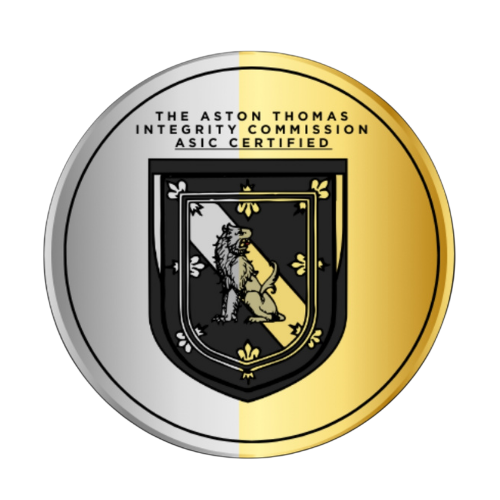
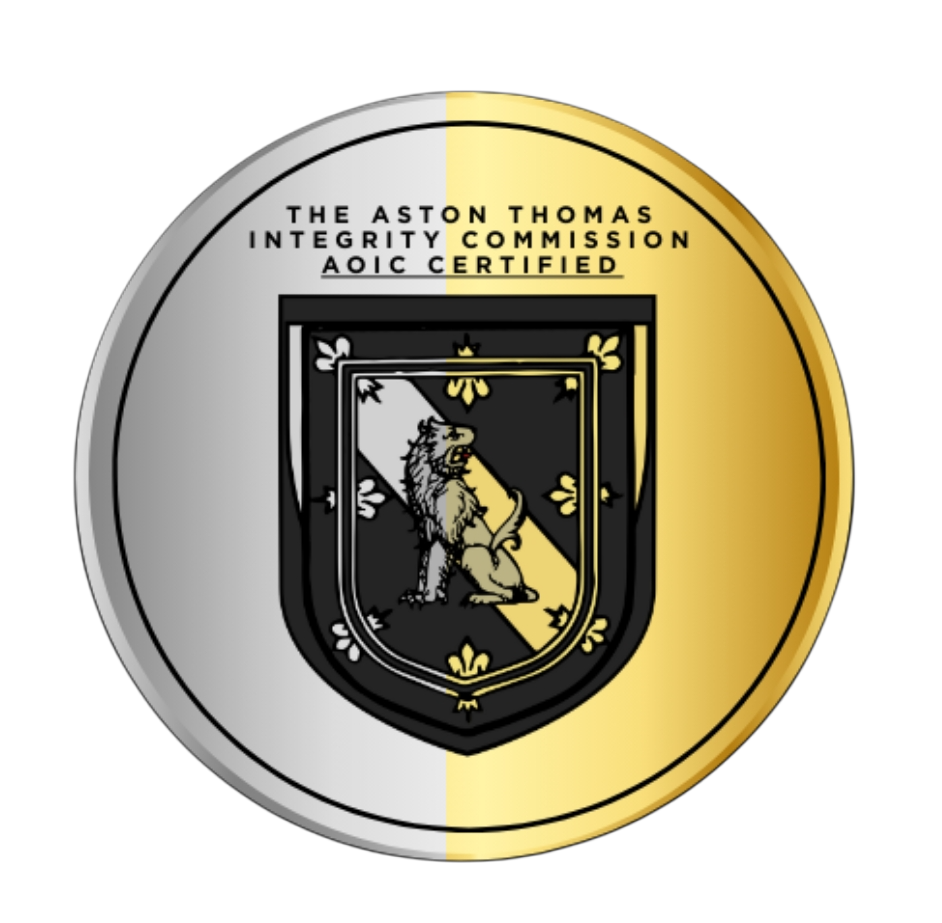
The SOC‑2, PCI‑DSS, and LEED equivalent for AI litigation.
-
ASIC verifies that an AI system is lawful, traceable, and defensible across its full provenance, from initial sourcing through deployment.
-
AOIC certifies that an organization’s governance, oversight, and operational practices meet ATIC’s institutional standard for responsible AI development and deployment.
-
The Transaction Due Diligence Assessment independently evaluates AI provenance risk and governance maturity for acquirers and counsel, protecting transactions from undisclosed AI liability.
The Litigation Standard
The forensic benchmark for legally defensible AI
The ATIC Standard is the Commission’s benchmark, defining the minimum conditions required for an AI system to be lawful in origin, traceable in lineage, and defensible under legal and regulatory scrutiny across all jurisdictions in which it operates. It is the standard against which all accredited certification bodies evaluate AI builders and deployers globally.
Read the Regulator Alignment Briefing →
Three scenarios where ATIC is the difference
When it matters
When an AI system faces copyright claims, data sourcing disputes, or system liability allegations, certification against ATIC's standard provides pre-existing, independently verified documentation of due diligence, produced before the dispute arose under neutral conditions.
01
Litigation
When regulators investigate AI deployments, certification against ATIC's standard demonstrates independently validated governance practices, not self-produced assurances constructed under investigative pressure.
02
Regulatory Scrutiny
When AI assets are acquired, certification against ATIC's standard gives acquirers independently verified forensic documentation of AI provenance risk, protecting against inheriting undisclosed legal exposure.
03
Transactions
Public Declaration for AI Integrity

The Declaration unites individuals and organizations behind a single principle — AI must be lawful in origin, traceable in lineage, and defensible under scrutiny. Signatories join a growing coalition reshaping how AI is created. Organizations may go further as Declaration Hosts, displaying the commitment within their communities and being listed in the Public Declaration Registry.
Take the Next Step Toward AI Integrity
→ The Provenance Standard Understand the principles and evidence requirements that define legally defensible AI.
→ Regulator Alignment Briefing A dedicated resource for policymakers, public agencies, and oversight bodies.
→Why No Existing Institution Can Do This No standards body, government framework, or private firm can produce what ATIC produces. Here is why.
→ Seeking to Volunteer for the Commission Learn more or contact us if you’re interested in volunteering.